Swede Talk, Swede Talk

A few random notes from a blog by Nobel Prize Winner, Paul Krugman:

1. Stockholm isn’t perfect. Even in August, it can rain cats and dogs — which is why I’m still sitting in the lounge blogging over my coffee and herring.

2. More seriously, I wouldn’t want to live here — because I’m not Swedish! Culturally I’m very much an American, Northeast Corridor edition, and even the Swedes tell me that their society can feel a bit claustrophobic. Fundamentally, my home is in the real real America — the multicultural, multiracial, freewheeling society that is built around the American idea. Of course, the “patriots” of the right hate that America.

3. Of course the point is not that Sweden is perfect, it’s the fact that it works and thrives despite high taxes and a strong welfare state — which isn’t supposed to be possible according to conservative dogma.

An anecdote here: Robin and I were talking yesterday with an eminent American financial economist, and said something about tax levels here. He said, “Well, that’s why all the young people are leaving.” Except, you know, they aren’t. But never mind — that’s what’s supposed to be happening, and it must be happening.

Politics week Swedish style


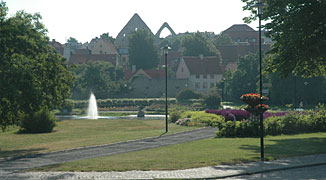
Once a year, at the beginning of August, there is a politics week in Sweden. The week takes place in an open-air park called Almedalen on the Baltic island of Gotland, and attracts heavy media coverage. Every day of the week belongs to a specific party that has a seat in the parliament. Quite conveniently there are 7 parties.

The Alemdalen politics week all started 40 years ago when legendary Swedish Prime Minister Olof Palme spoke publicly. It was at the end of the 60s and the Social Democrats on the island took the initiative and asked Olof Palme to make a speech in Almedalen. Palme and his family had spent their summer holidays on the neighbouring island of Fårö for many years. The stage was a lorry platform at Kruttornet and there was an audience of a few hundred people.

Now Almedalen politics week attracts thousands of participants and is intended to involve the man on the street in politics and to protect the strong Swedish value of democracy. However, the concept of democracy has never been so strongly challenged as it is this year. Right wing, national socialist party Sweden Democrats won seats in the the Swedish parliament last year. This entitles them to their day at Almedalen. Despite strong criticism and outcry, today is their day.

Although giving a free platform to racists is a difficult thing to stomach, the act strongly reflects the Swedish belief in democracy. Although we don’t all agree with each other, we have to defend the right for each other to think differently. If we don’t do that, what’s left? What kind of a society do we have then? I am sure it would be a society that we wouldn’t want to live in.

At Almedalen politics week, we meet each other in debate. And in debate and discussion, we influence each other and our environment. And it is then, and only then, we can possibly change our society.

Defining Swedish

Back in June, I participated in a citizenship ceremony. Yes, I became Swedish. But does a Swedish passport really make me a Swede? The ceremony was attended by hundreds of people from all walks of life and all parts of the world. Africans, Asians, Middle Easterns, Europeans, Americans, Australians were participating to receive their Swedish acknowledgements and to drink coffee and eat cinnamon buns. But are we Swedish? And what is a Swede anyway?

A radio program the other day was discussing this issue. They were talking about the Swedish soul. The essence that makes all Swedes Swedish. One member of the panel was disturbed. She claimed that such discussions were bordering on racist. She suggested that Swedishness needed a new definition.

What is a Swede then? Well, it’s simply those who live here.

Royal Imported Snow


And so the snow has gone. We can see the pavements once again. Patches of green grass smile at us after several months’ absence. The sky is blue. The sun is shining. And spring, maybe, yes, spring is here.

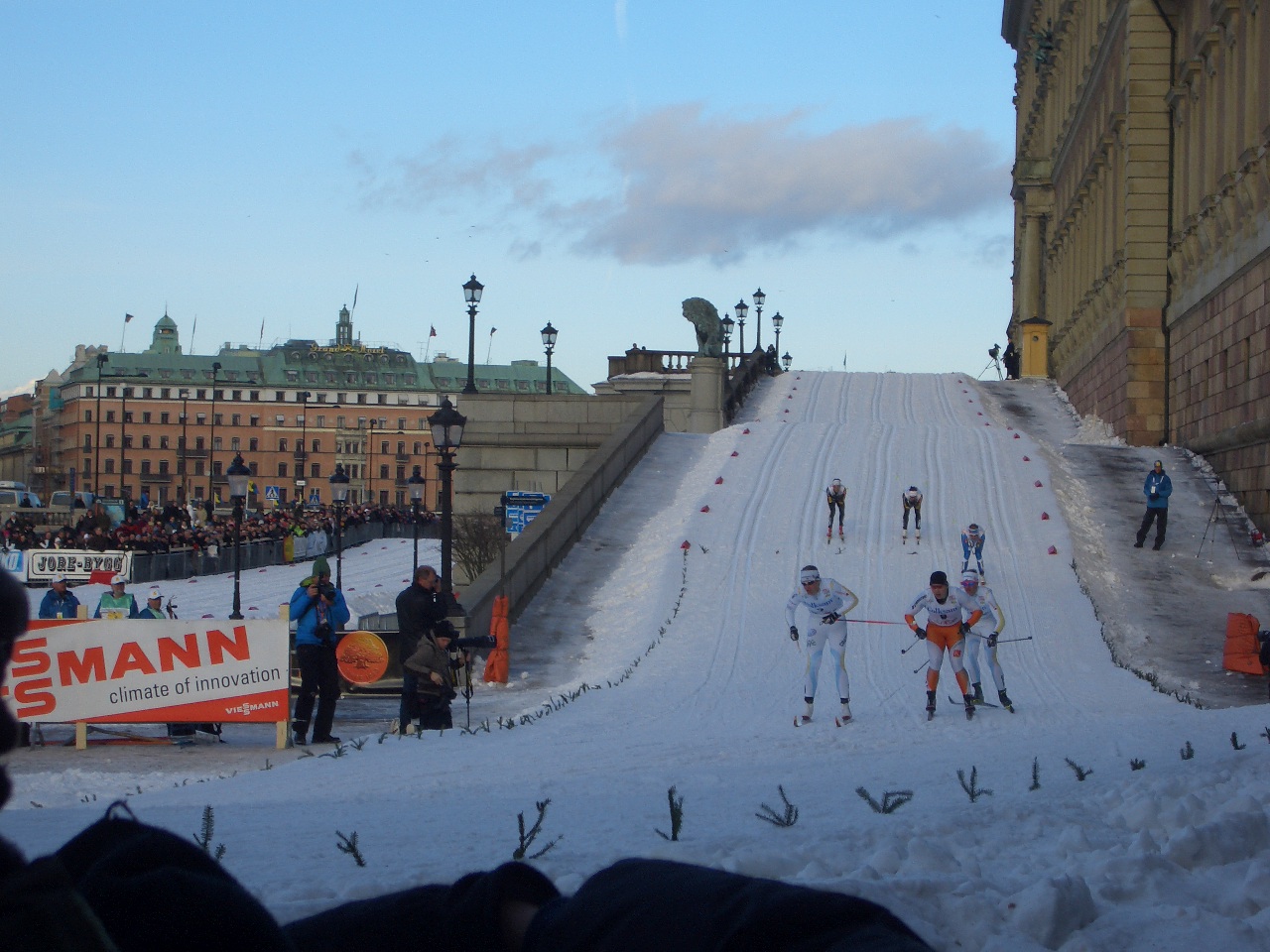
But not at the palace. Tons of snow has been shipped in and placed around the outside wall of the royal palace in central Stockholm. Not because the King has a particular penchant for snow, but because the Royal Palace sprint is taking place today. A world championship race, this sprint is, of course, on skis and the keen participants skirt the monarch’s outward rim in a sweaty, delirious blur of colour.

It seems to me like the transporting of snow into the city when the snow has gone is a strange idea. It seems expensive and not very environmentally friendly.

Why not schedule the race earlier in the year?

Like, in the winter, perhaps, when we have 4 months of natural unloved snow?

Cream buns for the girls


On International Women’s day this week a primary school on the Swedish island of Gotland came upon a good idea. They decided that, at the morning break, all of the boys would get crisp bread as their usual snack. But to celebrate International Women’s day all the girls would get a cream bun. Little did they know that this would create a parental and media storm to liken the Suez crisis.

At the end of the day, the kids went home and some of the boys complained to their parents that they also would have liked a cream bun. The parents were up in arms! How disgraceful! How terrible! What were they thinking?? How could they violate the rights of the boys and not give them the same as the girls?

This reaction made me think.

While admittedly the primary school maybe didn’t make a clever move, they did provide parents with an opportunity. Thinking parents should have sat their boys down and explained why the girls were given a special treat and why they have a special day. Thinking parents could have explained that girls around the world do not have the same access to education, or that they are married against their will, or that they are killed for speaking up against their fathers etc, etc, etc.

What an opportunity for the thinking parent.

Equality does not start with who gets a cream bun or not. It starts in the home, at the kitchen table, in dialogue between children and their parents.

Gay Swedish footballers

The image of Sweden as a liberal and open-minded country took a bashing this week. In comparison to many other countries in the world, Sweden is liberal. It is a place where, relatively speaking, minority groups can live safe in the knowledge that they are free from attack and protected by the law.

However, earlier this week, a popular young football player came out about being gay in the national press. The news was extra tantalising because the footballer in question is the son of a Swedish football legend from decades back. Many Swedes reacted neutrally to the news, not realy seeing any big issue around the fact that someone is gay – even if they are an elite sportsperson. But not everyone reacted in this fashion.

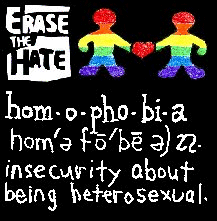
In the comments box on the football website http://www.fotbollskanalen.se, hate and homophobia flourished. In the end, the comments were so many, and so vile, that the website’s editor shut down the comments box. The hate that was spewed out had gone way over the limit.

This type of reaction indicates precisely why it is so good that footballers and other sportspeople come out. The macho culture, especially in football, means that many gay sportspeople are afraid to come out because they are afraid that their career will suffer or they will lose sponsors and fans. And as long as this fear exists, different sexual preferences will never been treated as equal, even in the democratic countries around the world.

So, in liberal Sweden, homophobia still exists. There is still work to be done.

The land of the lagom


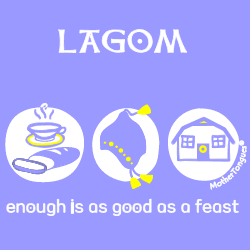
One of the first words you learn as a foreigner in Sweden is ‘lagom’. In English, there isn’t one word to sum it up. Roughly translated it means ‘enough, sufficient, adequate, just right’. Lagom is widely translated as ‘in moderation’, ‘in balance’, ‘optimal’ and ‘suitable’. While words like ‘sufficient’ suggest some degree of abstinence or scarcity, ‘lagom’ carries the connotation of appropriateness.

Similar to the concept of the middle path in Eastern philosophy, or Aristotle’s ‘golden mean’ of moderation in Western philosophy, it is said that the concept of lagom penetrates the Swedish way of life. Indeed the word lagom can be used in many situations to describe something that is ‘just right’.

Living in Sweden, you hear the word ‘lagom’ often. And just when you think you’ve understood it, something happens that makes it clear that you haven’t understood it at all.

For example, a person can be ‘lagom tall’ or ‘lagom short’ but that is not necessarily the same height.

Things can be ‘lagom funny’. Although said with some irony perhaps, what does this actually mean? That something is funny – but not too funny?!?

Lagom can also be used as an adjective – ‘that jacket is lagom on you’. Does this means it fits perfectly? Or does it mean it looks good enough – perhaps even mediocre?

And finally, things can be ‘precis lagom’, or precisely lagom. A concept that is so fuzzy for those of us not indoctrinated into it, can also be really exact.

The word lagom is generally believed to stem from the days of the vikings. When the vikings would pass around the mead to be drunk, it was important to take enough but not too much. The mead should last for the whole crew (in Swedish ‘lag’ + around ‘om’ Lagom = round the whole crew). Other etymologists claim that it comes from the Swedish word for law – lag – and means according to the folk law, or ‘according to common sense’ as we would say in English.

Whatever the origin, there is a meaningful cultural significance of the word lagom. The value of “just enough” is seen favorably in society as a sustainable alternative to the hoarding extremes of consumerism. But it could also be viewed as repressive – for example, it’s less ok to be too showy about wealth and power.

In a single word, lagom is said to describe the basis of the Swedish national psyche, one of consensus and equality. Despite a shift towards individualism and risk-taking in recent years, it is still widely considered ideal to be modest and avoid extremes.

But is Sweden really as lagom as it thinks in comparison to other contries? There are research databases that claim otherwise. I’ll talk about these in a later blog.

Right now, this amount of text feels, well,….lagom.

Swedish sex bombs


The myth of the Swedish sexbomb has been proven in the latest statistics from the Central Statistics Office.

The recently-released figures show that the population of Sweden is rapidly approaching 9.5 million. At the end of 2010, it was 9 415 570 people. This is an increase of 74 888 people since 2009. More people got married, more got divorced and birth rates are increasing.

I reckon it’s all thanks to the long, cold winters under the duvet and the wonderful, light, summer nights in the forest.

The definition of rape


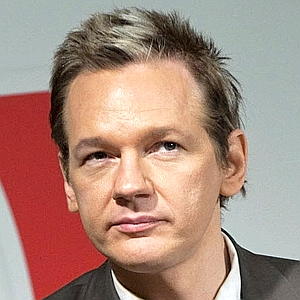
The current trial in the UK against Wikileak’s Julian Assange has cast the light on cultural attitudes to rape. The Swedish prosecutor is demanding that Julian Assange is returned to Sweden to face two counts of rape. His UK defense lawyer is trying to ridicule the Swedish definition of rape in order to prevent this from happening. In other words,saying what he did is not counted as rape in the UK and therefore he shouldn’t be extradited.

One of the women accusing Assange of rape has alleges that he used his body weight to pin her down. In the UK, the lawyer refered to this as simply ‘the missionary position’.
The other women accuses Assange of penetrating her when she was asleep/semi asleep and without a condom. The UK lawyer interpreted this as ‘half awake’ and if you’re ‘half awake’ you are consenting apparently.

The Swedish rape laws are amongst the toughest in the world, and I think that’s a good thing. In a country that believes in equality and integrity, I would expect nothing less. The attitude towards rape in Sweden – informed by a strong sense of women’s rights – means that it is more likely to be reported to police.

Some 53 rape offences are reported per 100,000 people in Sweden, the highest rate in Europe according to European jutice statistics.

The figures may reflect a higher number of actual rapes committed but it seems more likely that tough attitudes and a broader definition of the crime are more significant factors

Under Swedish law, there are legal gradations of the definition of rape.

There is the most serious kind, involving major violence.

But below that there is the concept of ‘regular rape’, still involving violence but not violence of the utmost horror.

And below that there is the idea of ‘unlawful coercion’. Talking generally, and not about the Assange case, this might involve putting emotional pressure on someone.

The three categories involve prison sentences of 10, six and four years respectively.

So, whatever Mr Assange did, it is in Sweden that he should face the courts. If it is a conspiracy, and he is innocent, it is terrible. But if he is guilty and protected by the UK lawyers, it is even more terrible.

No rapist should walk free. Ever.

Swearing till you’re blue in the face


Any foreigner arriving in Stockholm yesterday would have been surprised to see the tons of snow that were dumped on the city from the heavy sky. Even though they couldn’t speak Swedish, they would have picked up on one expression – a word that was heard on everybody’s lips. A word that had to be the most commmon word of the day yesterday.

The word? Fan!

The meaning? Something like fuck/shit/damn and used in this case in disappointment and dismay as the snow lashed down.

Swearing in Swedish is usually something I try to avoid. I think it’s difficult to swear in a foreign language because you don’t really understand the nuances and strength of the word in question. It’s easy to cause offence.

A recent article in a newspaper took up this issue of swearing in different cultures. All cultures have swear words and most of them are connected to what is considered taboo in that culture. Common themes are religion, genitals, toilet, sex and mothers.

In the Nordic countries, ‘mother’ isn’t such a loaded theme and therefore doesn’t feature in the common swear words. The strongest swear words are those connected to genitals, usually the female.

If you know more Swedish words than ‘fan’ and you’re interested in reading more, here’s the link:

http://www.svd.se/nyheter/idagsidan/samhalle/han-ar-expert-pa-svarande_5929059.svd