Death by music – Swedish style

Eurovision_Song_Contest_2013_official

This Saturday it starts – death by music.

Every Saturday for the next 6 weeks Swedish television is broadcasting the Swedish ‘Melodifestival’ – in which citizens choose the winning song to represent the country at the Eurovision Song Contest (ESC). Every Saturday for 90 minutes we listen to 8 songs, eventually narrowed down to a winner in the grande finale. Already, newspapers are abuzz with this event. And this year, even more so, since Sweden won the competition last year and is also hosting the ESC this year. The Melodifestival and the ESC are big news in Sweden. Probably due to the legacy of ABBA, the ESC is seen as a springboard to a fruitful and prosperous artistic career. The gateway to fame and fortune. This is quite unlike many other countries in Europe, not least the UK, where participation in the ESC is seen as a the final nail in the coffin of a dying career.

A couple of days ago, the celebrity host of ESC was announced – a controversial stand-up comedienne called Petra Mede. The nation was divided (at least those who cared). Newspapers wondered why a couple wasn’t chosen – why a woman was chosen to lead the event on her own! How would she manage without a man! What’s more, she’s pregnant! How is she going to be able to focus on the job when she has a new born baby at home?! Organisors of ESC responded to these comments quickly and categorically. Petra Mede is a very competent host, her baby will be looked after by its father and the reason we are not having a couple is to keep costs down. This is also the reason that the event will be held in a smaller concert venue than could have been possible. The organisors referred to the extreme cost of the latest final in Baku, and the fact that Portugal and Greece will not be participating this year due to financial constraints. Sweden should lead they way, they said, and take the whole competition down to a more affordable level so as not to exclude less wealthy countries.

Now, excuse me, but how is 4 televised Melodifestival competition heats in different Swedish towns, a fifth televised opportunity to qualify, a final televised Melodifestival competition in Stockholm, two televised ESC semi finals and one huge broadcasted ESC final in Malmö keeping the costs down???

Like I said, death by music.

You can’t believe everything you read


Scanning the internet, I discovered the following description of Sweden. Talk about the internet being a great way to spread false information! You can’t believe everything you read!

‘Sweden is the homeland of the great Moose and the majority of Swedes are dependent on it for their survival. Don’t go to Sweden for business purposes in September. It is most likely that the firm you’ll supposed to visit is closed down because of flu which is a swedish nickname for Moosehunt.

The yearly moosehunt, this is Sweden remember, is a folk feast heavily regulated by govermental legislation. Each county, every village, down to the very individual landowner gets a statistically based yearly quota on how many moose they have the right to shoot. For the average landowner this counts down to 0.0342 moose. Now how do you shoot 0.0342 moose? The best way is to team up with other hunting neighbors until you reach score one and then hump off to the woods with walkie-talkies and hope that you not shot each other or even worse – more than one moose, a catastrophy that could prevent your hunting rights for decades.

Swedish hunters always use the latest weaponry when hunting. However after an incident in 1912 when a tactical nuke accidentally killed some polish lingonberry-pickers, hunters were banned from using anything more destructive than paper airplanes. The ban was lifted 19 years later after country-clown Markoolio had been successfully assassinated with a flame thrower.

Now direct hunting is not the most important way to survive on the Swedish moose. More profitable is either to sell hunting rights to germans or moose related souvenirs to everyone else. The Swedish Moose Souvenir Industry is surpassed in the field of cheap mass produced gizmos only by toy production in Taiwan and lately the Wal-Mart’s Republic of China.

Even if the demand for Swedish moose puppets has rocketed on world market, business analyst believe that the sign of the future is export of the Moose warning traffic signs.

Moose manure paper is a huge profitable industry. Recently the paper quality has been good enough for printing dollars on, something that greatly has improved Swedens trade balance with the US.

Another successful product related to moose is the popular drink Tomtebloss, served at all nightclubs concerned of their reputation. The ingredients are: 1/3 home made booze 1/3 blueberry juice 1/3 lobster broth and a dash of Moose piss. This drink usually occurs together with Surströmming.’

Swedes abandon the church


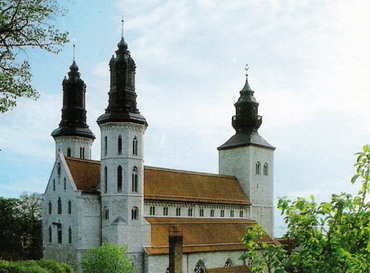
According to the World Value’s Survey, Sweden is one of the most secular countries in the world. In other words, the importance of religion in people’s daily lives is much less than in many other cultures.

And this is shown in an analysis released by the Church of Sweden’s chief analyst, Jonas Bromander. he claims that in the next ten years, the church will lose one million members´and this will lead to a loss of 1.5 billion kronor for the organisation. The obvious consequence of this will be cutbacks amongst the 23,000 employees and that many of Sweden’s 3700 churches will have to be shut down.

Is this the cause or the effect of Sweden’s secularisation?

The Swedish Hen Debate

I saw a sign on a newspaper stand today- ‘Are you provoked by hen?’. The hen that is being referred to is a new term of address that is gender neutral and that can be used to describe male or female. And this is why it’s provoking for some.

In Swedish, ‘han’ is he, and ‘hon’ is her. The term ‘hen’ is suggested to cover both. The pronoun was suggested in an article in 1994 – but actually it was initiated earlier than that. In 1966, it was introduced by journalist Rolf Dunås in a local newspaper in the town of Uppsala.

But why is it causing a storm now? In January this year, a children’s book called ‘Kivi and the monster dog’ was released. In the book, Kivi was referred to as ‘hen’. Was she a girl or was he a boy? The author deemed it unnecessary and the children readers didn’t mind. But parents, media, politicians and certain schools reacted strongly.

In another experiment,at a primary school in Stockholm, the teachers use the term ‘hen’ when talking about the children. The intention is to avoid pigeonholing children at an early age into a specific gender with everything that that brings with it. Again, mixed repsonses have been observed in the parents – some love it and othjers hate it.

In cultural studies, there is a dimension known as ‘Maculinity-Femininity’. This dimension refers to how clearly separated the gender roles are in a society. A Masculine society is a society where men do traditonal men’s things (work, fix the car, building, plumbing etc), and women do traditional women’s things (cook, clean, take care of children). A Feminine society is a society where these gender roles are less clear, where there is overlap between the sexes in terms of behaviours and expectations.

According to research, Sweden is the most ‘Feminine’ country in the world. So, it’s no surprise that there is a high awareness of gender neutrality and that it expresses itself in, for example, pronouns such as ‘hen’.

So, we may see ‘hen’ as a ridculous attempt to make everybody the same, or as a natural and logical progression of the Swedish belief in gender equality.

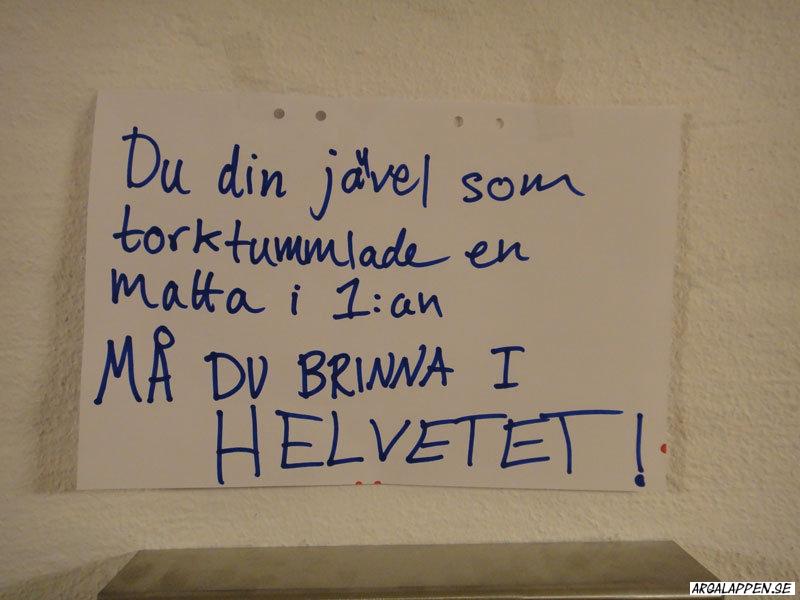
Battle in the laundry room


Most Swedes have never visited a public laundromat. Never had to carry their laundry on the bus to get to the nearest one. Never had to stand in line to wait for a machine. Never had to remain in the laundromat with the loaded machine for fear that the clothes might get stolen.

This is because, as a fantastic standard, all Swedish apartment blocks have their own laundry room and many Swedes also have a washing machine in their apartment. The communal laundry room is included in the service charge that each resident pays and, in most places, is a constant source of irritation and discussion. Typical bones of contention are:

– that it’s difficult to get a wash time
– that people steal each others was times
– that people use/borrow/steal washing powder
– that people don’t empty the driers of their clothes
– that people are noisy
– that people don’t clean up after themselves

There’s a lot to get irritated about and people really seem to enjoy fighting over the laundry room.

Swedes in general strike me as a cleanly people. It seems like the washing machines are in constant use and the driers are always humming. But sometimes this can go a bit over the top.

A family in the town of Karlstad have recently been in court because their neighbours complained they were too clean. Apparently, the couple were regulars in the laundry room – as much as 11 times per month. This created a lot of noise and made it difficult for the other residents to get access to the washing machines. The court ruled against the happy washers – in the eyes of law, they had washed too often.

It’s amazing what people take to the courts. And it’s even more amazing that there is a ‘law’ about what’s an appropriate amount of times to do the laundry in a communal laundry room.

I guess if you’re a clean freak and you live in Sweden, the conclusion is obvious – get your own washing machine!

Oh, those beautiful Swedes


Good news to all Swedes!

A recent survey was carried out by Travellers’ Digest about where the world’s most beautiful men and women reside. Their conclusion? The most beautiful men are in Stockholm! Stockholm’s women came in second position, beaten only by the lovely ladies of Kiev. Alexander Skarsgård, from True Blood, was provided as a classical example of the ‘hot Swedish guy’.

This is what Traveller’s Digest writes about Swedish men:

‘Swedish men have long been misunderstood. Case in point: they are often stereotyped as cold, emotionally distant loners and inexplicably mistaken for Swiss guys. On the plus side, they are also generally considered aesthetically pleasing due to their fine-boned Nordic attributes and exceptional height advantage. Although there always seems to be some truth to these types of classifications, in the case of these Scandinavian studs, the deeper reality is quite a pleasant surprise. Your average man in Stockholm is an impeccably-dressed clotheshorse that truly indulges in the enjoyment of the finer things in life: from food to fashion, culture to hearth. But what really makes them unique? Despite the fact that one must practice patience when engaging in the slightly bizarre ritual known as the Swedish courting process, once you have captured the heart and imagination of your elegant gent he will be devoted to you for life. What’s more irresistible than that?’

And for women, they write:

‘What you have seen on the beer commercials is true; Sweden really does have some of the world’s most beautiful women. The streets of Stockholm are literally packed with these gorgeous women, who are as tall as they are luscious. Even better, is that Scandinavians are world renowned for their friendliness, so there’s a good chance that the girl you’re eyeing is actually a sweet and down to earth person.’

But, don’t be dismayed, Swedish women actually topped the list of the world’s most beautiful women – this is what they wrote:

‘Sweden is firmly in first place on this list. The first time you visit Sweden is an unreal experience as you realize that everything you have ever heard is, in fact, true! The women are tall, blonde-haired, blue-eyed goddesses whom are friendly and educated to boot. There must be something in the air.’

I guess I’m lucky to live in Stockholm!!

Swedes love their cakes


Swedes love their cakes.

And this week has been a major cake week that has given the economy a real boost. First on Tuesday, people stuffed down the creamy, marzipany lent buns known as semlas. And today, local bakeries around the country are reporting that a certain item is sold out. The shelves are empty. And what might this item be?

Prinsesstårta, or Princess Gateux, of course.

A new princess was born in the night, so today everybody wants Prinsesstårta.

Why? Group think.

Group think is a very interesting cultural and psychological phenomenon that occurs within groups of people or whole societies. It is the mode of thinking that happens when the desire for harmony and belonging to a group overrides individuality. It creates a positive feeling in the group or society as it provides ‘social glue’. However, the negative cost of groupthink is the loss of uniqueness, and independent thinking.

So, princess born = princess cake for many people in Sweden.

Let’s hope they christen her Princess Mazzarin or Princess Tosca. That should boost the economy even more.

(Note: Mazzarin and Tosca are other popular cakes in Sweden)

A new Swedish princess is born


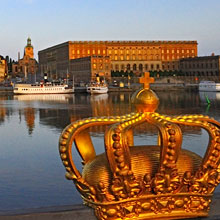
In the middle of the night, Sweden got a new Princess. She has no name as yet, so right now she’s Princess Thing. Not only has her mother, Crown Princess Victoria, given birth to her first child but she has also provided Sweden with the next monarch.

Unlike many other countries in the world, Sweden’s line of succession to the throne goes to the first born, not necessarily the first son. Sweden adopted this equal progmeniture in 1980 when the current king had his first child, which happened to be a girl. Up until 1980, the throne went to the first-born son. For example,the king himself is the youngest child with several elder sisters.

This change on the law reflects clearly the Swedish belief in gender equality even up in the higher echelons of society. Nowadays, it sounds ridiculous to us in Sweden that elder sisters would forgo their right to inheritence/title/estate just because they are female and have younger male siblings. It feels dusty and old-fashioned.

Only in 2011, was there an agreement in the UK to change the law in a similar way. Any future child of William and Kate, regardless of gender, will be heir to the throne after William.

Communist warning on the streets of Stockholm


The other day, I couldn’t believe my eyes. My chin nearly hit the floor with what I saw on one of the busiest streets in central Stockholm.

Sweden is, for many, associated with socialism, even ‘communism’, depending on your particular political leaning. And what I saw in central Stockholm really reminded me of the stereotypical images we have of the communist USSR.

In Sweden, the government has an alcohol monopoly, which means you can only buy wine and spirits in certain shops called Systembolaget. These shops are dotted around city centres and have restricted opening hours. Obviously, they’re very popular because Swedes are not known for their reservedness when it comes to alcohol consumption.

Anyway, in central Stockholm, next to the main railway station there is a Systembolaget. The other day, I needed to buy two bottles of white so I decided to go to this particular branch. As I approached it, I couldn’t believe my eyes. This is when my chin nearly hit the floor. I saw something I’ve never seen before. Outside the shop, there was a long queue to get in. A bouncer on the door was letting customers in gradually. People were queueing up to buy alcohol. Hello! Communist warning!

Now, I happen to be a fan of Systembolaget. Often, there’s a very good range of quality products, the price of wine is very competitive and it’s a way of supporting improved public health. The main argument against it, of course, is the questionable ethics of a monopoly and the fact that it is a clear example of state control over individual freedom and choices. I haven’t really prioritized the latter in this case – up until now. Seeing the queue of people freezing in the snow until they could get in to buy a bottle of wine seemed somehow very wrong. It was really a kick back to times that most people would rather forget.

So, anyway what happened?

Of course, I got in line and stood at the back of the queue and shuffled along slowly with the rest of the drones until I was allowed in to purchase my two bottles of Chardonnay.

All we need is love


Today is Valentine’s Day in many countries around the world, including Sweden. Many Swedes embrace the celebration with flowers, chocolates, dinner dates. Other Swedes react negatively to it as it is an ‘imported tradition’ – an Americanisation. But what Swedish tradition isn’t imported? They all are, we’ve just forgotten where from.

I understand the anti-commercialism arguments, the same resistence that arises around Halloween. But the way I see it is this. We live in a globalised world, with global influences. This means that there are flows of people, products, beliefs and traditions. Of course, globalisation brings with it negative aspects, and also positive things.

A celebration such as Valentine’s day is about celebrating love.

And love is something that, in a seemingly harsher world, we could all do with a little more of.