Street begging in Sweden – what to do about it?

Tiggare

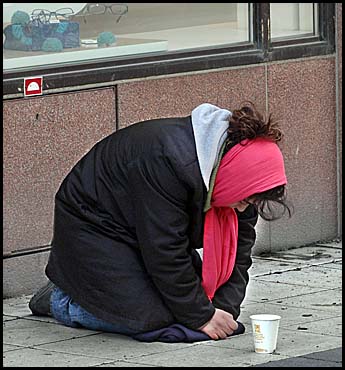
Did you know that Sweden is one of the few countries in the EU where begging is not illegal? A so-called ‘begging crackdown’ came into force in 2011 which criminalized the activity. Beggars on the streets of Swedish towns are becoming more and more common and I, amongst others, have a difficult time deciding what to think about this. On the one hand, we’ve all heard about the gangs of beggars and the organization of donation gathering as a source of income for the gang leaders. On the other hand, there is the individual person sitting on the street freezing in the November rain.

A good friend of mine made a very helpful comment recently that enabled me to reflect over my feelings and I wanted to share that with you. This is what he initially wrote on FB, which created quite a debate (I have loosely translated it into English):

‘There she sat, in the rain. Outside Coop. With her cup and her threadbare clothes. And I stepped out of my car and searched impatiently in my wallet amongst my gold ten krona coins to pay for a trolley. Have to swap this cash, I thought. This wallet’s so heavy with all this loose change. So…..impractical. That’s what I thought. When I walked past her. Without looking. In the rain. Because you know that it’s organized crime. I’m not going to contribute to that. No. So I went shopping, as you do on a Friday. A little bit of Brie from the deli counter, which melts in the mouth. And some other nibbly bits to eat in front of the open fire this evening as the rain beats against the window pain. Have a cosy Friday. The woman at the till was happy to receive all my change, I got a 100 krona bill in exchange. I throw my items into my bag and walk out to the carpark. And there she sits. I stop. I think. I question myself. What kind of person am I? I take the bill out of my wallet and put it in her cup. Where it belongs. I’ve got enough, unlike her. And she still doesn’t.’ (Calle Mikelsens)

This comment on Facebook caused a debate about begging in Sweden and whether Swedish people should accept it or ignore it. In order to explain his point of view, my friend Calle, added another comment which changed my perspective on the issue. This is what he wrote:

‘My reason is clear. I believe in the meeting between people. That I can do what I can but at the same time understand my limitations. Sometimes ten kronor or a hundred krona bill can make a big difference. I don’t want to limit myself by thinking globally but I want to instead do something. We can’t solve poverty with charity. We solve it through political action and taking a stand. But we can, along the way, help those who are at risk of falling. And feel anger every time we put money into the collection tins. I am, despite my naivity, not convinced that a political shift will eradicate world starvation. That requires a larger movement. But I feel that there is a wind of opposition sweeping over the world despite the greed and the grabbing. I have to do what I can on my small scale. That’s where I have to begin…’

So, it’s all about each of us making a choice. Do we want to look at the global perspective, in which the individual often gets lost? Or do we want to look at the local perspective, and understand that what we choose to do, or not to do, can have an impact on another person’s life?

The dark side of Sweden

Hate_intel

I can’t deny that I am disappointed, outraged and sad all at the same time.

As is obvious from my blog, I love Sweden. I love the values that underpin society and the social behaviours, sense of justice and attitudes that have developed from these values. I often write about the openness of society, the belief in equality and human rights.

But there is a dark side to Sweden. And it has reared its ugly head today.

In the media today and on the TV tonight, the issue of internet hate was debated. About ten Swedish journalists and media profiles, all female, had gathered to share the comments they have received from mostly anonymous people via the internet. Comments such as ‘whore’, ‘cunt’,’slag’ and ‘bitch’ were commonplace as were threats of murder, mutilation, gang rape, public humiliation and general mysogyny. All of these women had the same thing in common – they had expressed feministic views and/or they had criticized the right wing political party Sweden Democrats. They were all perceived as a threat to the patriarchal norm.

This particular case looked at the threats and personal attacks received by women and I am also sure that male journalists and media personalities also receive threats. Putting the feminist perspective aside for the moment, it is not acceptable for anybody to be threatened for expressing their viewpoint. It is not acceptable in Sweden, it is not acceptable anywhere.

Living in democracy in Sweden means freedom of expression – the political right to communicate one’s opinions and ideas. In practice, the right to freedom of expression is not absolute in any country and the right is, as in Sweden, commonly subject to limitations such libel, slander, obscenity, sedition (including, for example inciting ethnic hatred), copyright violation, revelation of information that is classified or otherwise.

In other words, in Sweden people have the right to say what we think without the fear of their lives or safety being personally threatened. Criticizing societal structures is self expression, calling somebody a ‘cunt’ and threatening to murder them is not.

In my view, these internet haters are criminals. They are blackmailers, anonymous thugs and cowards. And they bring shame on the Swedish brand, this country that paves the way internationally when it comes to human rights, gender equality and self realisation.

There needs to be a sharpening of the legislation around internet hate comments in Sweden, as the current law covers printed material, which the internet technically is not. Sweden does not live up to the conditions set out in the European convention and could in fact be sued by the EU. But how do you word new legislation without infringing on the right to self expression as seen from the Swedish perspective? This is the dilemma.And in the meantime, as policymakers decide what to do, these violations keep happening.

They say that nothing grows in the dark, but in some Swedish people, hate is thriving.

Always wear gloves to wipe tears

It has been a while since I blogged about Swedish culture. I guess I needed a break. I have seen many blogworthy things during the last months but chose not to comment, until now.

On Swedish TV, a new drama is being broadcast which is causing a lot of reaction in social media and in the press. Author Jonas Gardell has decided to tell the story of the AIDS era in 1980’s Sweden. This is a story that has never been told – and it is  high time.

Although it may seem like a long time ago, the so-called AIDS crisis was only 25-30 years ago. A short time in the history of humanity. And Jonas Gardell’s story portrays a cold and uncaring Sweden, a country where Hiv patients were treated with disrespect and utter disgust, nursed by people in rubber gloves and face masks and then disposed of. Where it was acceptable to call gay men revolting, say that they spread AIDS, that they were a threat to society, that they should be incarcerated against their will, that they deserved to die. This was only 25 years ago. This opens a gaping wound in a Swedish society that prides, and markets, itself on equality and human rights. Where were these for gay men 25 years ago?

Of course, Sweden wasn’t alone in this. In the UK and the USA and many other countries the attitides were the same and in many parts of the world, such as our neighbouring Baltic countries. this is still a reality today. In Sweden, it is something that belongs to the past, thankfully, although the stigma of Hiv still weighs heavily in society.

AIDS decimated a whole generation, my generation.  Jonas Gardell’s drama has brought back a lot of terrible memories for me. These ghosts from my past are welcome in my life however. And I thank Jonas Gardell for that. But as I watch the programme, I am reminded of something that Astonomer Carl Sagan once said ‘you have to know the past to understand the present’ and I wonder how the younger generations of gay people see this story. Do they relate to it? Can they relate to it? Do they see this as part of their heritage, their cultural identity? Or is it a case of having to be there…

Our stories have been consciously erased from the history books by people in power. We have been made invisible.

But now our story is being told. And it steps out into the cold light of day to be seen and known by everyone.

http://www.svt.se/torka-aldrig-tarar-utan-handskar/

Swedish protection in Addis Abeba

And so the Swedish journalists in Ethiopia got prison. 11 years for illegal entry and terrorism. I feel sorry for them and their families. ‘Merry Christmas’.

The outrage in Swedish media, however, is interesting from a cultural perspective. The trial has been called ‘unfair’, the case condemned as ‘political’ and the African system as ‘corrupt’. Is this true or is it a case of Swedes taking the moral high ground?

Anthropologists are yet to find a culture that thinks their way is wrong. And judging by this case, this is a very relevant discovery for Swedish culture. It seems very often in Swedish media, and even amongst Swedes themselves, that no other legal system is as honest and fair as the Swedish one. All African and Asian judicial systems are deemed unjust, as are most European – and the American system is seen as flawed.

Is this the reason why Sweden has given itself the role of the social and political conscience of the world? The neutral, peacekeeping and mediating nation? Because at heart Swedes think they’re right and the others are wrong?

My recurring feeling is that this belief gives some Swedes a false sense of security. Wherever they are in the world, they feel protected by the superiority of Swedishness.

The particular case in Ethiopia is, of course, a tragedy all round. And although the perpertrators may very well not be terrorists, they certainly did enter the country illegally. As journalists, they saw it as their duty to report on one of the most closed regions in the world. But they got caught.

And, although they might think so, I’m afraid being Swedish won’t protect them in Addis Abeba.

The land of invention


Right now, I’m in an intense period of travelling for work. Backwards and forwards I walk from home to the airport train, out to Arlanda airport and off.

Picture this. Minus 20 temperatures. Snow tumbling down. Pathways covered in deep layers of snow, rutted and ribbed from pedestrians and pushchairs.

There I go. Head, neck, hands, legs, feet freezing because I’m only wearing a thinnish suit under my coat. Behind me, I pull a suitcase. A suitcase on wheels. I drag it, with much effort, through the piles of snow. It gets stuck in a snow-dune. With a wrench, I jerk the suitcase out and continue, head down into the wind and towards the station. I curse the fact that the pavement isn’t ploughed, and that the snow just keeps falling, falling, falling.

Sweden is a country that has fostered many inventors. For having a relatively small population, a very large amount of inventions have come out of this country. The safety match, dynamite, the blowtorch, the AGA stove, the safety belt, the zip, the ballbearing, the pacemaker and dialysis machines. All Swedish inventions.

Now, you’d think in such a small country of big brains, someone would have invented a suitcase on skis wouldn’t you? So many problems would be avoided.

I would definitely buy one.

A die hard Swedish stereotype


The problem with stereotypes is that they are often out of date and frozen in time. The British stereotype of a polite, thin, uptight man with a bowler hat and brolly still prevails,even though most British men stopped dressing that generations ago.

When I googled ‘Sweden pictures’ today, the picture above came up first. It seems like the stereotype of Swedish women as blonde, promiscuous bimbos is still alive and kicking. This stereotype has rooted itself firmly in the international psyche thanks to fleshy films of the 1960’s.

That was 50 years ago and says a lot about other cultures’ prudish attitudes to sex and nudity.

It saddens me that we haven’t moved on since then.

My letter to the Greens


If, like me, you believe that the Green Party should cooperate with the minority government in the name of democracy, then I urge you to send them an email declaring this. This has even more impact if you are a member of the Green Party. Rarely before has it been so important to take your citizenship, or residency, seriously and communicate what you feel. Send your comments to service@mp.se

Here is the mail I sent yesterday. I apologise to those of you who don’t speak Swedish. And to those of you who do, I apologise for my Swedish.

Jag heter Neil Shipley och jag blev svensk i juni i år. Detta val var mitt första riksdagsval. Jag tog uppgiften på största allvar och läste på de olika partiernas mål innan jag bestämde mig för att rösta. Jag känner mig stolt med mitt beslut.

Nu har vi situationen som vi har med ett främlingsfientligt parti i riksdagen. Som invandrare själv tycker jag att det är av yttersta vikt att våra folkvalda representanter hittar ett sätt att lösa detta. Den toleranta Sverige som jag älskar ska inte gå förlorad.

Fredrik Reinfeldt har sagt att han vill gärna öppna diskussioner med er för att skapa ett eventuellt samarbete och på så sätt slipper beroende på rasisterna. Jag uppmanar er att gör detta i demokratins namn. Det är upp till er. Om ni inte gör det så ökar chansen att regeringen är tvungna att samtala med SD. Och det skulle vara förödande för svensk politik och samhället. Vi måste visa omvärlden hur vi hantera situationen på ett mänskligt och moget sätt och inte gå samma väg som Danmark till exempel.

Jag hoppas att de flesta av era väljare inser hur viktigt detta är. Det är inte att bara visar avsky för främlingsfientlighet, det är även att agera. Och ni har alla möjligheter att göra detta. Även om det inte är det mest önskvärd situation måste vi göra någonting av det. Dessutom är det även en möjlighet att få fram Miljöpartiets hjärtfrågor ändå och påverkar.

Så av alla de röster som ni fick, här är min. Prata med Fredrik Reinfeldt. Lös detta. Och gör mig och Sverige stolta.

A deeply disturbing thing


I am disturbed. Very disturbed. I sit at my desk and should start working. My mind drifts. I can’t focus.

A deeply disturbing thing has happened in Sweden – something that threatens the foundation of society and turns the idea of Swedish tolerance and egalitarianism on it head.

On Election Níght last night it became clear that the Swedish Democrats, a national socialistic, racist party, have been elected into parliament. With just under 6% of the vote (360,000 votes), they have 20 seats.

But that’s not the worst of it. These 20 seats give them the balance of power, since the current government were re-elected, but with a minority.

This is a shock to the other 94% of Swedes who didn’t vote for them. People mention the right-wing gales that are whistling over Europe and that have now reached Sweden. They talk about the xenophobic disease which has infected Swedish politics.

The Prime Minister last night said he will never cooperate with the national socialists. Can we trust him to keep his word when his power is what’s at stake?

There is talk of solving the problem through cooperation across the blocs in order to elbow out the Swedish Democrats and render them impotent. It will be interesting to see what happens.

Can the different parties put aside their prestige and return to their shared basic assumptions about life and people? That we are all equal. Can they work together to uphold democracy as the majority see it?

Today, Sweden became a colder place.

It’s now up to our elected politicians to turn up the heat on the racists that have wormed their way into the Houses of Parliament.

No immigrants


Only two days to go to the election and, in the latest polls, the Swedish Democrats are increasing their share. The Swedish Democrats (laughable name) are a right-wing, racist party that want to send immigrants home and to reduce immigration to Sweden by 90%. In a report in the newspaper today, a journalist explained how Sweden needs immigration. Being such a small country, and the fact that Swedes are not rampant breeders, we need immigrants to grow and develop. Without immigration Sweden will stagnate.

As a reaction to the Swedish Democrat’s policies, a new Facebook group has opened. It’s called Inga Invandrare (No Immigrants) and it is working hard to show lost Swedes what good things immigrants have contributed to the nation.

What would Sweden have without immigrants and their influence?

No pizza
No sushi
No kebabs
No football goals
Shut down hospitals, nursing and retirement homes
Dirty streets
Only ‘dansband’ music, and some watery pop
No new buildings
No modern Swedish language

And much, much more.

And although I choose to be non-political in this blog, on this occasion I make an exception.

Do not vote for the Swedish Democrats.

Not unless you want a colder, dustier and stagnant Sweden.

Postal order democracy


When I came home from work, there it was lying on the mat in the hallway. A little slip of paper, quite innocent. It told me to go to my nearest newsagent and pick up a parcel that they were holding for me.

So, the next day, I trot down to the newsagent, recyclable bottles in one hand, the dog’s leash in the other. After recyling the glassware, I walk into the newsagents and pick up my parcel. Well, actually it is an envelope. A big, white envelope. With a logo on. On closer inspection, I realised that the logo is three crowns and the letter is from the Immigration Office.

I walk over to a neighbouring park and sit down on a bench, my dog lying at my feet. The sun is shining, and a slight breeze comes across the lawn. I open the envelope with bated breath.

Inside the envelope is a certificate.

It says, ‘This certifies that Neil Shipley has been awarded Swedish citizenship.’

So you see, I am now a Swedish citizen! I have double citizenship of Sweden and of the UK. And it feels good.

People ask me why I applied for citizenship after 16 years of living in Sweden. For me the answer is simple – it’s a question of democracy. I have chosen not to vote in the UK since I don’t live there. I have not been allowed to vote in Sweden. I have been in a democratic wasteland. But now, I can vote in the general election that takes place in a couple of weeks. And I think that’s important.

Being Swedish makes everything just more simple. Apart from in one respect. This blog – ‘Watching the Swedes’.

Does my citizenship mean that I have to watch myself too?