The Short Swedish Summer

  
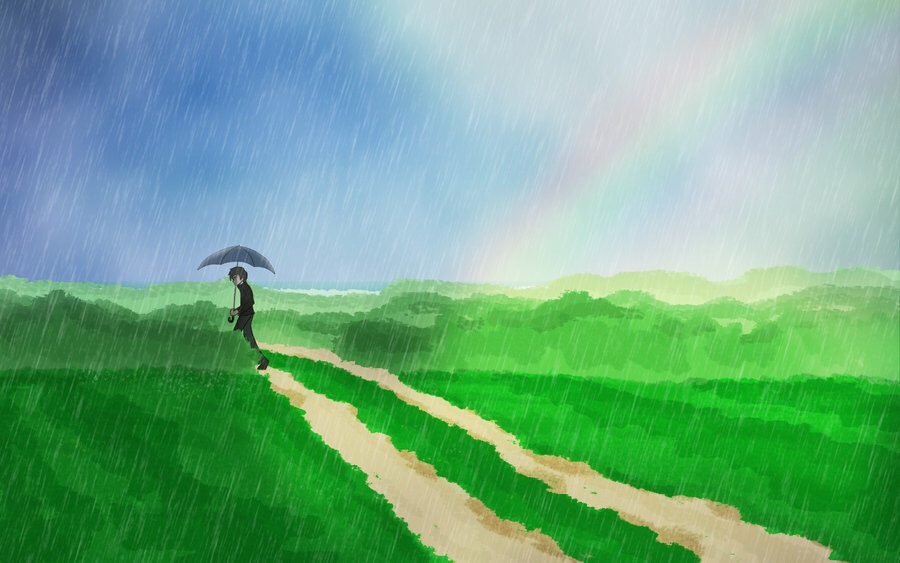
In Sweden there’s a series of classic songs that are strongly related to the summer. One of these songs, I have always hated. It’s by an aging pop star called Thomas Ledin. I fear his summer song may be coming true this year. 

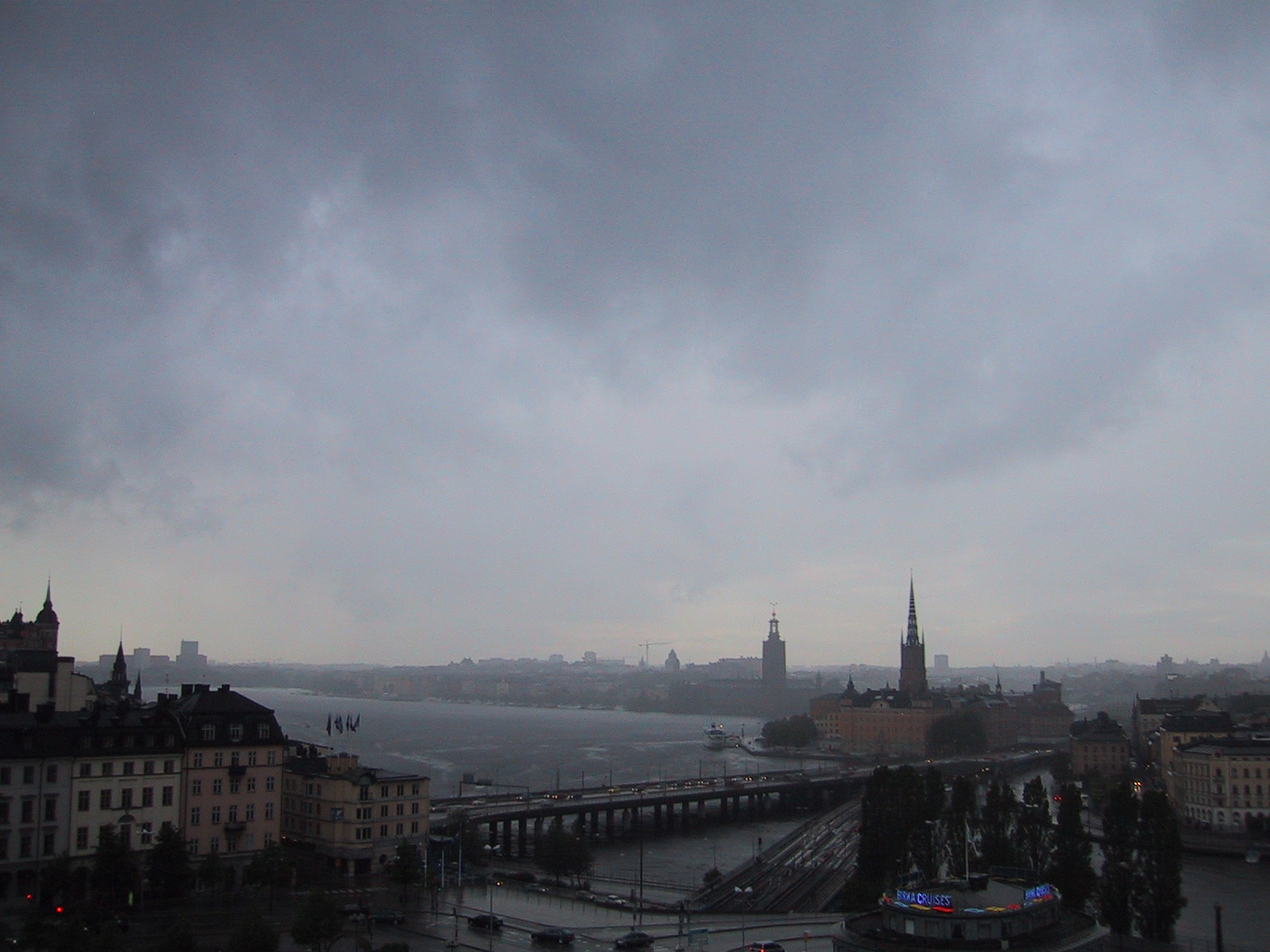
This year, we’ve had the rainiest May and June in human memory. We had a heat wave of 5 days at the beginning of July. And today? It’s 14 degrees and raining again. So much for summer. Maybe that was it last week, flashing by in the blink of an eye. 

So what is Thomas Ledin’s song? In Swedish it goes ‘sommaren är kort, det mesta regnar bort’ which translates as ‘summer is short, most of it just rains away.’

Art meets life in an annoying, but this year truthful, summer melody. 

Swedish weather gods

rainstockholm

At the moment, I’m hearing a lot of moaning about the weather. It is raining a lot and unusually cold for the time of year.

Or is it?

I remember the first year I moved to Sweden and I was returning to the UK on May 13th to visit family. At Arlanda Stockholm Airport our flight was delayed – because it was snowing!! Snowing on May 13th! When I arrived in London, it was over 20 degrees and people were walking around in shorts.

I also remember another year – on Midsummer’s Eve – in June that we sat outside and it was so cold our breaths were steaming. It was the same temperature on Midsummer’s Eve as it had been on New Year’s Eve.

And I remember another May morning a few years ago when I was late for a meeting beacuse I had to unexpectedly scrape the ice of my car.

So is it so unusual that it’s this cold at this time of the year? Unfortunately not. Up here in the Nordic region, this is what we can expect from our weather gods.

The only thing that can make it change is global warming – not selective memory, collective denial or wishful thinking.

Baby we’re burning – Swedes, songs and Satanists

valbiorg

This weekend, the 30th April, in Sweden is Valborgsmässoafton. Yes, another one of those long indecipherable Swedish words.

This one translates as Walpurgis Eve, and is a day enshrined in tradition not only in Sweden but in other European countries such as Germany, Holland, the Czech Republic, Lithuania, Latvia, Estonia and Finland. Rather Baltic in other words.

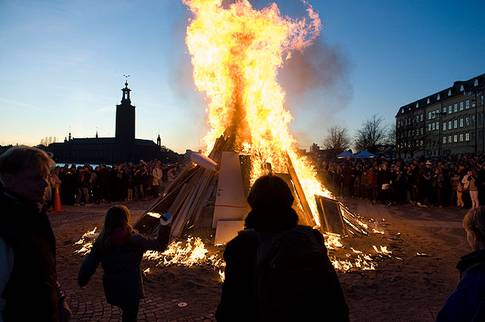
The name ‘Valborg’ is from an English Saint but, despite that, this isn’t really a religious celebration. It’s more to do with the welcoming of spring, and feels rather pagan actually. In the evening on Valborgsmässafton, Swedes gather around huge bonfires and listen to songs. These songs are in the form of traditional choir music designed especially for this occasion to shake off  the nasty dark winter and celebrate the burgeoning buds of the lighter season.

And like many traditions in Sweden, this one also has a rural origin. These bonfires are part of a Swedish tradition dating back to the early 18th century. On this day, farm animals were let out to graze and bonfires lit to scare away predators and other evil beings. This is rather ironic as Walpurgis Eve is also an important holiday in Satanism at it marks the founding of the Church of Satan.

But religion aside. On Walpurgis eve, I am watching the Swedes watching the flames, listening to music and looking forward to the spring and summer months ahead.

We survived another winter, and summer is coming!

Dorky Swedes – Töntiga Svenskar

dork

For all of their advancement in technology, social issues and equality politics, many Swedes are also hiding a less sophisticated side to their culture. Scratch the surface, and its not far to their dorky side.

I’ve often reflected over this when I go to clubs here in Stockholm. Like many venues around the world, Stockholm nightclubs can have more than one dance floor. The dance floors are often divided into music types, for example, techno, house, pop…..and Eurovision. Usually, the Eurovision dance floor is the smallest one, as the club owners probably don’t want to appear unrefined.  But it is usually the fullest of all the dance floors. It is packed with Swedes shaking their stuff and screaching – loudly – to the lyrics of Carola, Conchita and Loreen. It is so unbelievably dorky. And I love them for it.

Let’s change scenario and go to a house party. Hand shaking, polite conversation and rosé wine. All very cultivated. Fast forward five hours when people have knocked down a couple of bottles of plonk. The cool bossa-jazz background music has been changed and a Spotify competition has evolved playing…….Eurovision. Party guests are bopping around to the old-time Euro melodies such as ‘Good Vibrations’, ‘It Hurts’ and ‘ABC’. It is so unbelievably dorky. And I love them for it.

So what’s the deal? Why do the otherwise cool Swedes turn into a bunch of yahoos when they are at parties or  nightclubs? Well, maybe in a world of technology, of digital communication, of stress and demands, Eurovision music provides escapism. Its simple melodies and inane lyrics don’t require any effort or thought. The basic rhythms can just wash over you and, for a moment, you can forget the seriousness of the world beyond.

It’s either that or the fact that Swedes are just dorks when they drink.

Sweden’s Pink Thursday – washing and witches

jesus feet

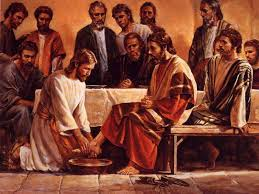
Today, the Thursday before Easter is called Skärtorsdag in Swedish. As the word ‘skär’ translates as a shocking pink colour, many people joke that today is ‘pink Thursday’. But the word ‘skär’ in this case relates to something else – something far more biblical.

The word ‘skär’ is an early Nordic word meaning clean and pure. And here, we see a parallel to the English word for ‘Skärtorsdag’. In English, today is called ‘Maundy Thursday’ and it relates to the religious rite known as ‘the maundy’ which involved the ritualistic cleaning of feet. According to Christian belief, today was the day that Jesus performed this act until the recipients had clean and pure feet. It also is the day of the infamous Last Supper.

However, in Sweden today, ‘Skärtrorsdag’ is not celebrated in any great religious fashion but in a pagan manner. A old pagan belief in Sweden was that on this day witches would mount their broomsticks to fly away to the legendary mountain known as Blåkulla. At Blåkulla it was believed that the devil held his earthly court. There the witches celebrated their sabbath and danced with the devil.

In modern day Sweden, we see this reflected in the many children who dress up as witches. These kids paint Easter cards and walk around the neighbourhood knocking on doors to wish everybody a happy Easter. In exchange, they hope to receive Easter sweets.

påskkkärring

Don’t let those Swedes fool you

april fool

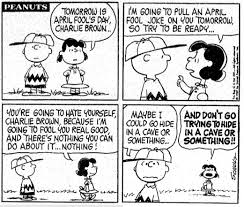
Today is April 1st, which is celebrated in many countries, including Sweden, as April Fool’s Day. On this day, you are allowed to commit pranks and jokes on people – all in good spirit of course. The earliest reference to April Fool’s Day is in Chaucer’s Canterbury Tales from 1392, but nobody really knows the origin of this tradition.

One common place these jokes take place are in the newspapers, and it’s fun to sift through them to see if you can identify what’s real news and what’s a hoax.

Today, a few of the jokes that have been identified in the Swedish press are:

– Banks are going to start charging entrance fees, roughly the same as a cinema ticket

– Princess Madeleine plans to give birth at Västervik’s Hospital in Kalmar. The hospital is currently investing in trendy uniforms in order to appeal to the princess, who is very interested in fashion.

– The three naked beaches in Varberg are going to be closed. Nudity is no longer ok.

–  On the island of Gotland, in the Baltic Sea, the local council will introduce parking fees for the entire Island. In this way, the people who live in the countryside are treated the same way as those who live in the main town.

– In Karlstad, a wind turbine has mysteriously disappeared

– In Katrineholm, 300 house owners are being offered fiber broadband for one krona if, today, they fax in their name, address and a motivation in poem form as to why they deserve fibre at such a low price

– An American hamburger chain is launching a perfume in Japan that smells of hamburger. Called ‘Flame Grilled Fragrance’ it will cost 360 kronor.

In Sweden’s largest national paper, Dagens Nyheter (Daily News), I Think I have identified not one, but two, April jokes!

– 700 000 homes are going to lose their TV channels since the Swedish broadband supplier has failed to reach agreement with SBS Disney. Alot of very popular TV programs will be inaccessible from today.

– In a studio in a Stockholm suburb, a designer has developed figure-huggin outfits for female priests. Now her clothes are a global success.

I’m sure there are a lot more out there in the media. What others have you seen?

If you fall for these lies, the expression to say in English is ‘April Fool!!

In Sweden it’s ‘April! April! You stupid herring!‘ (Now, that I’m afraid is the truth!)

Sweden’s Easter Art Drive

konstrundan

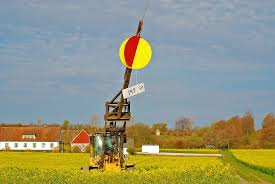
Soon it’s Easter break with 4 lovely days off for most of us. In Sweden, this is a time that many people go out to their country houses or travel abroad to warmer climes. If you’re still in Sweden, and looking for something to do, one suggestion is to head south to the county of Skåne, and the region within Skåne called Österlen. Every year, over Easter, this area hosts an Easter Art Drive, or ‘Open Studios Week’ where you can travel around and get a rare glimpse into the homes and studios of working artists.

This event started in 1968, when a few artists decided to open their studios to the public. Within six years, this had expanded to well over 60 artists welcoming people directly in to their places of work. Most of the artistic fields are represented – sculptors, painters, textile artists, glassblowers, silversmiths, ceramic artists, printmakers, handcraftsmen, wood and computer artists.

It is a fantastic experience. Driving through the beautiful Swedish countryside between villages, wandering amongst the studios built from renovated barns, drinking coffee in the temporarily opened out buildings and hen houses.  The artists themselves are usually there and it is easy to engage in conversation about their work and their inspiration. Everything is for sale, so you can also leave Easter week with a unique and reasonably-priced piece of art under your arm.

For more information, check out http://www.oskg.nu/english

Sweden Lesson 2: getting off a bus

bus

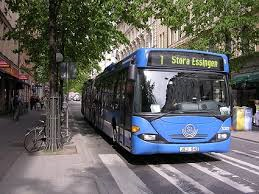
You’re on a bus and you wish to disembark. You are however blocked by somebody sitting next to you, or standing. How do you get off the bus?

Two stops ahead of your preferred stop, start indicating with your body that you might want to soon make a move. Move your knees towards the other person, shift your weight to one buttock. As you approach your required stop, make a demonstrative move to press the stop button and hope that they see this. If they do not start to move, turn your body directly towards them. Look at the side of their heads. Under no circumstances speak to the person. Just look at them. If they still do not move, start to rise slightly in your seat. As they move out of the way, push quickly past them. Avoid eye contact. Do not say thank you. If they do not move, as an absolute last resort, say ‘ursäkta’. The person will then move. Do not make eye contact. Do not say thank you.

Cleaning up the Swedish language


Every year, SAOL, the Swedish Academy Ordlista (word list), is published. This list includes new additions to the Swedish language and removes or updates old words that are no longer in use. 2015’s list is due to be released next month, and this time, the Academy have made suggestions that clean up the Swedish language by suggesting that we do not use offensive and controversial words. 

Instead of ‘neger’ (nigger), they are suggesting Swedes say ‘black’

Instead of ‘Lapp’, they are recommeding ‘Same’

Instead of ‘zigenare’ (gypsy), they are suggesting ‘Roma’

For me, this is a no-brainer. It is extraordinarily old-fashioned and offensive to continue to use the three listed words above.  I would hope in 2015 that we had come further than this. There are people who will defend the use of these words by saying that they have the right to use what vocabulary they want. Of course, they are correct. That’s called freedom of speech. But having the right to do something doesn’t mean doing it. If by exercising my right I am violating or oppressing others, then I would suggest we make other choices.