The hottest place on the planet


I was at the Stockholm Jazz fest last night. A mixture of conceptual jazz, jazzfunk and acid jazz was on offer. The festival is held on Skeppsholmen, an island in the harbour. From this island, Stockholm really does show its best side, with its magical mixture of blue water, big sky and lush greenery. But last night, the weather gods were not on our side. Biting winds, black clouds and chilling rain dominated the evening, and festival visitors sat huddled around tables, swathed in blankets and drinking wine out of plastic cups.

In Sweden, when the summer comes, you sit outside even if the weather is appalling. You might need a fleecy jumper, a scarf and a blanket, but it’s the summer. And in the summer you go to festivals, sit outside and enjoy it.

The main artist of the night was rap star Missy Elliot. She bounced onto the stage at around 11.30 with gangster dancers and ‘hiphop hotboys’. The crowd jumped up and down hysterically – mostly to keep warm. And the heavens opened, and the rain came tumbling down.

Missy’s show was great, a real highlight. At one point she shouted in her microphone ‘Someone told me that Stockholm is the hottest place on the planet!!!’

That could only be said by someone who hadn’t sat there shivering for 5 hours.
When the politicians listen


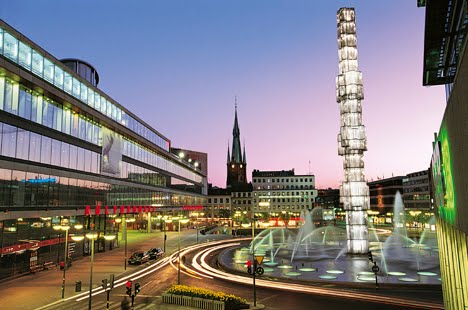
When students graduate from Sixth Form College in Sweden, they go on a procession around the city. Part of the route takes them through Sergels Torg, a heavily-trafficked square in the centre of Stockholm. Politicians decided at the weekend that the students would not be allowed to go through this area this year.

And there was a public outcry. The students started a Facebook group and demonstrated against the decision. And today, the decision was rescinded. The students can go through Sergels Torg as they have always done.

On the tv, they interviewed the 19-year old student who had started the protest. They asked him how he felt. He answered

‘I think this shows that politicians listen. And that we really can influence them and make a difference.’

What a fantastic lesson for a 19-year old boy to learn on the day of his graduation.

Stockholm A-Z: Exercise


E is for exercise

This weekend was the Stockholm Marathon. It was a fantastic spectacle of sporty Swedes and other foreigners stamping the 40 plus kilometers around Stockholm. Thousands of people lined the streets cheering, singing and dancing. The sunny summer weather had brought them out in droves.

Standing on the side of the road, cheering on my partner, I was impressed by the amazing effort that all the runners were investing.

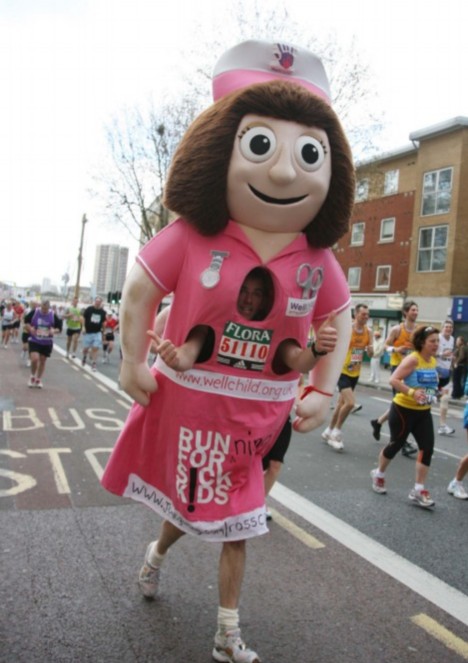
I was also struck by the main difference between the Stockholm Marathon and the London Marathon – fun runners in funny costumes. The London Marathon is full of them. People dressed as chickens, as donuts and as marshmallows run the route, usually for charity. In the Stockholm Marathon, the concept of the fun runner in funny costumes is not very common. During the time I watched, I saw a few funny hats, a robber and a bumble bee. Otherwise, it looked very serious. The participants were focused runners, not fun runners.

And this, for me, reflects a crucial part of Swedish culture. People here take their exercise very seriously.

Stockholm is an exercise-friendly city. Every morning, lunchtime and evening, hundreds of joggers run along the many waterside pathways. Cyclists take over the city this time of year and perilously navigate the cycle tracks and roads. Strollers, speedwalkers, stickwalkers,skaters,skateboarders are all out on the streets. Canoists bob around the canals in colourful kajaks. People play kubb and boule in the parks. Every neighbourhood has at least one gym – and they are all packed. Swimming pools, squash courts, yoga studios abound.

In Stockholm, it feels like everybody exercises in some way. And I guess it pays off.

Visitors often remark that Stockholm is populated with so many good-looking people, of all ages. And they wonder why it can be so.

I hate to admit it, but could it be something to do with exercise?

Why do Swedes drink so much?


‘Why do Swedes drink so much?’ was a question I recently received in an informal survey on Facebook.

And it’s a revealing question. A common stereotype that other nationalities have of Swedes is that they get rip-roaring drunk – frequently. And it’s easy to understand why this stereotype exists.

Anyone who’s been involved in a Swedish celebration of any kind has experienced the close presence of alcohol. At Midsummer, people get drunk. At crayfish parties, people get slaughtered. At Christmas, the snaps comes out and people end up hammered. In seaside destinations abroad, it’s not uncommon when you see a gang of drunken youngsters that they are Swedish. The beer you buy in pubs might be expensive but it is so strong it’ll make you cross-eyed after three glasses. So it’s easy to form the impression that Swedes are hardened drinkers.

In today’s newspaper, the results of a recent study were published. Swedish consumption of wine has increased 60% in the last ten years. This is easy to measure since all wine is purchased in Sweden through one company – the state-owned monopoly Systembolaget.

In the newspaper article, Swedish citizens were asked why they thought this increase has happened. In other words, why do Swedes drink so much?

Citizen 1: ‘Because we have adapted a more cosmopolitan drinking style. It is no longer shameful to have a glass of wine on a Tuesday after work.’

Citizen 2: ‘Because we are doing so well in Sweden. Everybody is better off so we can treat ourselves a little more.’

Citizen 3: ‘Because of the introduction of the ‘Bag in Box’ wine. It’s so easy to drink a lot without knowing how much you are drinking. It’s easier to tap a glass of wine than to open another bottle’

I’m sure it is to do with all of these things. Interestingly, I think we are witnessing a cultural rebellion. Society is shifting from the collective to the individual. The old days when the government controlled alcohol consumption for the sake of public health is disappearing. It is being replaced by individual responsibility and individual choice. And the initial reaction is overconsumption.

So, there are lots of reasons why Swedes drink so much.

Now my question is, why do the Brits drink even more?

Stockholm A-Z: Djurgården


D is for Djurgården

For me, it’s easy to forget about the island of Djurgården. It feels so far away. But actually, it’s not very far at all. A 10 minute bike ride or a 20 minute run and you are there.

Djurgården is the ‘pleasure island’ for Stockholmers. Located in Stockholm’s harbour, it hosts museums, galleries, gardens, a zoo, a funfair, a market, cafés, restaurants, a theatre, hotels. The list goes on.

When I first moved to Sweden, I used to think it was stupid to have so many museums concentrated in one area. I used to find it tedious to have to go out to the same destination every time I wanted to go to one of these museums.

But I have changed my mind. I think Djurgården is amazing.

It is one of Stockholm’s truly unique features. Going to Djurgården is like visiting a sanctuary, away from the stresses of urban life, where it is all about focusing on recreation.

The existence of Djurgården is deeply engrained in the Stockholmers’ minds, and strongly rooted in history. As far back as the 1200’s, the island was a royal hunting ground. In the 16th and 17th centuries, the focus shifted from royal hunting to recreation for the public. The 16th century historian Olas Magni describes ‘sculling girls conveying lads and maidens out to play and disport themselves.’

But the true rise of Djurgården happened in the late 1800’s, when a horse-drawn omnibus line was created linking the city to the island. And in 1897 the great Stockholm Exhibition took place there.

This put Djurgården firmly on the map where it still remains today as one of the Stockholmers’ most favourite places to disport themselves.

In the garden of (Sw)Eden


Runny nose? Itchy eyes? Headache? I think I can easily diagnose what is wrong with you.

Summer is here. The sun is high. The air is warm. The burgeoning trees are in full bloom and the air is heady with pollen. You are probably, like me, one of the 10% of the world’s population that suffers from pollen allergy. In Sweden, there are tens of thousands of people who are allergic. It’s raging wild. It’s like a national epidemic. They innoculated us against swine flu. Why not this?

According to statistics I saw the other day, Sweden has the highest rate of pollen allergy per capita than most other countries in the world. Why is this? Various theories abound.

Some say that Swedes are simply too clean. They are so squeaky clean that they cannot deal with bacteria and other alien elements, such as pollen, in their environment.

Others say that Swedes are soft. The long winter indoors doesn’t equip them for the amount of pollen that explodes in their eyes and nostrils this time of the year.

Others claim it is the nature of the flora in Sweden that makes the residents more susceptible. Birch, widely present in Sweden is, apparently, a nasty old pollen producer.

Whatever the reason, one thing is clear. It is one of life’s ironies.

After a long winter, the beautiful Swedish summer finally arrives. But many people can’t be outside because of the poisonous pollen.

I guess it’s just to squirt in the eye drops, pop the allergy pill, step out into the park and accept that even paradise – the garden of (Sw)Eden – had a snake.

Throw us a crumb


And so Eurovision is over, and Germany won.

But not to worry, Sweden was still strongly represented. The Swedish song may have fallen at the first hurdle, but the whole contest was full of Swedish dancers, backing singers, choreographers and songwriters. There was even a Swedish celebrity pianist on stage backing up Belarus.

Without Swedish involvement, the contest wouldn’t have been as professional. So we can also see 2010 as a Swedish success, according to commentators and journalists.

I guess it’s good to be grateful when you get thrown a crumb from the banquet table.

A reality check is needed


Tonight is a night of anxiety for many Swedes. In fact, the last couple of days has been quite traumatic for them. You see, on Thursday, Sweden failed to qualify for the Eurovision Song Contest final which is being broadcast tonight.

Sweden sent a sweet girl, Anna Bergendahl, with a sweet song, to the semi final in Oslo. And Europe voted. And Sweden failed to impress the voters. And Anna was on the first bus back to Stockholm.

The next day, the papers were full of headlines screaming ‘Fiasco!’ and ‘Ban the Eurovision shit’. It was unjust, they claimed. Anna deserved better. Sweden deserves better. Europe is just jealous of our musical talents so they don’t vote for us. Eurovision should be changed! There should just be a Nordic Eurovision! Sweden should pull out immediately. The rhetoric was rabid, and the people were livid.

Sweden takes its Eurovision very seriously. Since ABBA won in the 70’s, and put Sweden on the musical map, it’s been a matter of national interest and pride to participate in the yearly contest.

But now, it’s fanatical.

One debate in the papers and on the television is about how Europe’s music is inferior to Sweden’s. They claim that all Europe’s music is basically rubbish and Sweden’s is the best. Sweden always sends great songs to the Eurovision Song Contest but they never win. This is because European voters are too stupid, or too tasteless, to appreciate good music.

I have rarely heard such blatant arrogance before.

A reality check is needed. The fact is that Sweden’s results in the Eurovision Song Contest have gone from bad to worse every year, while other Nordic countries have won. Sweden’s music is not the best, in this context. Sweden is out of touch with what music appeals to the masses in the rest of Europe.

What’s worse is that Sweden makes the mistake of believing that the Eurovision Song Contest is a contest for the best song. It isn’t, and it never has been. It is about politics, nationalism and entertainment. It always has been.

So, if winning is important, this is my advice to Sweden. Do not vote for the song you think is best. Vote for the song you think will do the best in Europe. Even if you think it is rubbish, chances are that millions of Europeans will disagree with you. Vote strategically.

Maybe then you will have a shot at the glory and recognition you obviously desperately desire.

A walk down the aisle


Isn’t it funny how something small can be so meaningful? In Sweden, it is less than a month until the Royal wedding when Crown Princess Victoria marries Daniel Westling. The party is planned to last two weeks, culminating on May 19th in the cathedral.

And it’s what will happen in the cathedral that is causing a huge stir. Victoria has stated that she wants her father, the King, to escort her down the aisle and give her away at the altar. Not so strange, you might think. Not so controversial. But in Sweden, this is causing a storm.

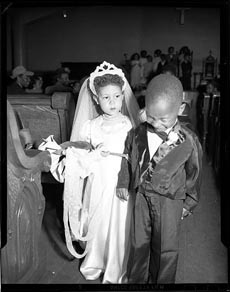
A father giving away his daughter at her wedding is not a Swedish tradition. In Sweden, the bride and groom walk down the aisle together towards the altar where they are then married. This is a major symbolic action. In Sweden, a woman is not something that is owned by one man and can be given away to another man. A woman is strong, independant, mature and educated. She is fully capable of walking down the aisle on her own, together with the man she has chosen to marry. She is not anybody’s property. This is yet another way in which the Swedish value of equality is exhibited in society.

That the future queen chooses to go against the tradition is a break in protocol. It is also seen by many, including myself, as a lost opportunity to communicate to the world’s press that in Sweden men and women are equal.

Of course, Princess Victoria should be able to do what she wants to do at her own wedding, but let’s not forget that she has a responsiblity to the nation, especially when the nation is funding her wedding. A future regent, if anyone, should be seen to uphold and promote the values of the country she represents.

If she doesn’t, what then is the point of a monarchy?

Stockholm A-Z: Café life


Café Life

Like many cities with diverse seasons, I find that Stockholm can be schizophrenic. In the winter, Stockholmers walk quickly to their destinations, head-down often avoiding social interaction on the street. This is understandable. It is so cold, you just want to get indoors.

In the early stages of summer though, the city changes.

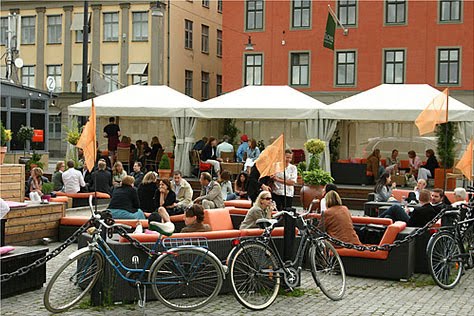
The sunnier, warmer weather comes and restaurants spread out onto the pavements and streets. It seems like even the smallest of cafés has an outside terrace. It might only consist of one table and two chairs, but it is still an outdoor terrace. Outdoor summer cafés open up for the season on quaysides, in parks and squares.

And the people flock to them in droves.

Café season is the start of beautiful people season. All winter, Stockholmers have been hidden under layers of thermal clothing. But now, they cast off their outer garments and slip into their summer outfits, their sunglasses and their shorts and sandals. A more grateful and beautiful nation I am yet to find. You wonder where all these Amazonian women and athetlic men have been hybernating for the winter half of the year. Oh, of course…in the gym.

Café life has a strong tradition in Swedish culture. It is still possible to find traditional coffee houses dotted about the city. A window to the past, they often still have the original decor and atmosphere. Swedes are amongst the top 5 countries when it comes to the consumption of coffee, and this is part of the reason why coffee is so good in most cafés. Even 7 Eleven has decent coffee. This is also why Starbucks considered Stockholm to be a saturated market long before they opened their first store at the airport earlier this year.

But it is the outdoor café that reflects life for the modern Stockholmer. Weather permitting, these are the perfect places to sit and watch the world go by. Infraheaters and blankets help keep any irritating chill at bay. So, grab your outsized sunglasses, head to a square, slip into a chair, order a macchiato and enjoy summer life in Stockholm.