A deeply disturbing thing


I am disturbed. Very disturbed. I sit at my desk and should start working. My mind drifts. I can’t focus.

A deeply disturbing thing has happened in Sweden – something that threatens the foundation of society and turns the idea of Swedish tolerance and egalitarianism on it head.

On Election Níght last night it became clear that the Swedish Democrats, a national socialistic, racist party, have been elected into parliament. With just under 6% of the vote (360,000 votes), they have 20 seats.

But that’s not the worst of it. These 20 seats give them the balance of power, since the current government were re-elected, but with a minority.

This is a shock to the other 94% of Swedes who didn’t vote for them. People mention the right-wing gales that are whistling over Europe and that have now reached Sweden. They talk about the xenophobic disease which has infected Swedish politics.

The Prime Minister last night said he will never cooperate with the national socialists. Can we trust him to keep his word when his power is what’s at stake?

There is talk of solving the problem through cooperation across the blocs in order to elbow out the Swedish Democrats and render them impotent. It will be interesting to see what happens.

Can the different parties put aside their prestige and return to their shared basic assumptions about life and people? That we are all equal. Can they work together to uphold democracy as the majority see it?

Today, Sweden became a colder place.

It’s now up to our elected politicians to turn up the heat on the racists that have wormed their way into the Houses of Parliament.
Election Day


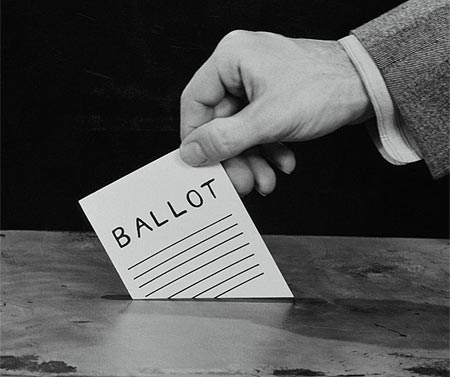
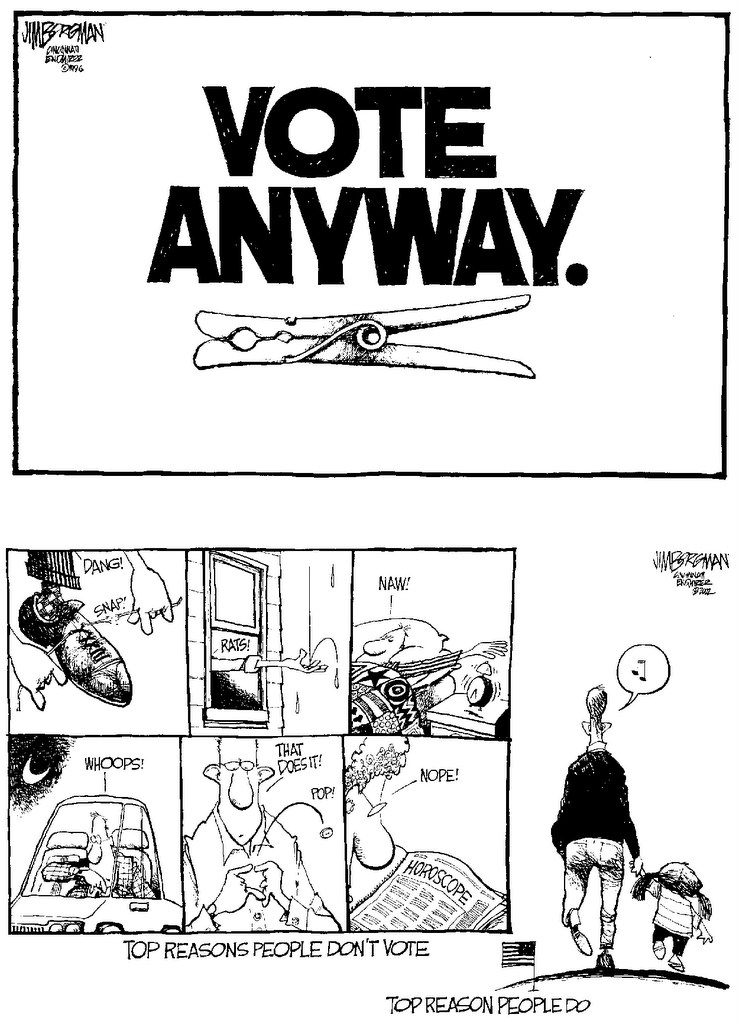
And so it’s election day.

All the parties have been campaigning up to the last minute, trying to sway the thousands of voters who still haven’t made up their minds. By the lake today, one party, the currently-reigning Moderates, were offering coffee and cinnamon buns to passers-by in exchange for a little chat about the election.

The tv has been full of election issues. The papers have been packed with it. The streets have been full of campaign workers and, for the first time, the parties have been knocking on doors. Apparently, never before has so much focus been placed on the election and on increasing election turnout.

This interested me. So I checked the IFES Election Guide to see how parliamentary election turnout compares between different countries.

And, to be honest, Sweden does really well already.

In the last election, the election turnout in Sweden was 81.99%

Compare that figure to the UK (65.52%), Switzerland (49%), Czech Republic (39.12%) and Hungary (30.94%).

The best countries are Belgium (91.80%), Malta (93.30%) and, wait for it, Luxembourg (100%!!!)

Of all the 70 countries in the list, only 11 have a higher election turnout than Sweden, many of them only very slightly. That’s not a bad statistic, which reflects that Swedes, in general, take their democratic rights seriously.

In Sweden, voting is not only a right. It is a duty.

No immigrants


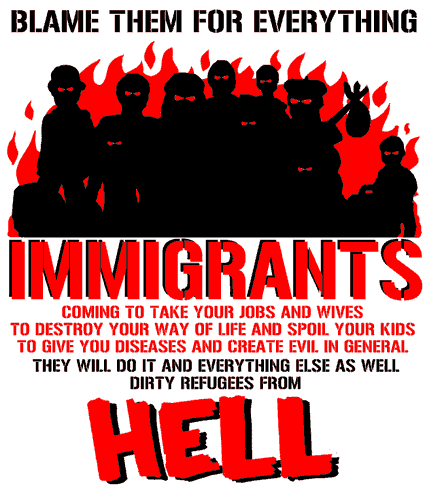
Only two days to go to the election and, in the latest polls, the Swedish Democrats are increasing their share. The Swedish Democrats (laughable name) are a right-wing, racist party that want to send immigrants home and to reduce immigration to Sweden by 90%. In a report in the newspaper today, a journalist explained how Sweden needs immigration. Being such a small country, and the fact that Swedes are not rampant breeders, we need immigrants to grow and develop. Without immigration Sweden will stagnate.

As a reaction to the Swedish Democrat’s policies, a new Facebook group has opened. It’s called Inga Invandrare (No Immigrants) and it is working hard to show lost Swedes what good things immigrants have contributed to the nation.

What would Sweden have without immigrants and their influence?

No pizza
No sushi
No kebabs
No football goals
Shut down hospitals, nursing and retirement homes
Dirty streets
Only ‘dansband’ music, and some watery pop
No new buildings
No modern Swedish language

And much, much more.

And although I choose to be non-political in this blog, on this occasion I make an exception.

Do not vote for the Swedish Democrats.

Not unless you want a colder, dustier and stagnant Sweden.

Concrete blocs


At first glance, Swedish politics can be a bit confusing. Unlike the UK, or the USA, there are 7 major parties all vying for the voters. You’d think with 7 parties, it’d be easy to decide who to vote for. But it isn’t. Apart from the far left and the far right, all the other parties seem very similar.

This time round, however, the parties have tried to make it easier for us by forming two blocs: the Alliance to the right, and the Red-Greens to the left. Two concrete blocs to choose from when we are standing in the polling station on September 19th.

Or at least that’s the theory. The trouble is that both blocs are making the same election promises. More money to pensioners. Better schools. Better healthcare. More jobs.

The forming of the two blocs has made the decision even more difficult, and in the end it may become simply a choice between the far left or the far right.

To get clarity, I decided to ask some Swedes what the main ideological difference is between the two blocs. And surprisingly, they couldn’t really tell me. Lots of people couldn’t tell any difference at all. Some people made a brave attempt to explain. I heard things such as,

‘one side wants to reduce tax by 1%, the other wants to increase tax by 1%
‘one side believes in benefits, the other in jobs’
‘one side wants to put more money than the other into the public sector’

None the clearer, I will have to chew over my options. Before election day, I’ll decide. Like millions of other voters. And a new government will be chosen.

And we’ll probably notice very little difference.

Who you gonna call?


In a few weeks, Sweden will be voting for a new government.

One Swedish phenomenon around election time is the ‘valstuga’. The ‘valstuga’ is a little rustic hut placed on squares, in parks, on road junctions, outside shopping centres and erected by one of the many political parties. In these little colourful huts you can find little representatives of the respective party that built the hut. Like in a fairy tale, you can go into the hut and talk to them and ask them questions about why they should get just your vote.

This brings the politicians closer to the people. It also brings the countryside, never very far away in the Swedish pyche, into the cities.

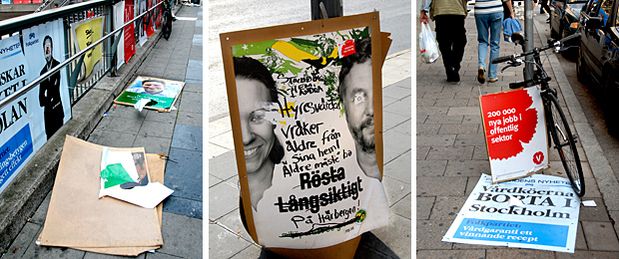
Another phenomena is the ‘valaffisch’, or election poster. As in many other countries, each party has campaign posters on which they promote their main message or their main personalities. In Sweden, these posters pop up overnight. Pasted on fences, walls, lamp posts, doors, walls, they paste the towns with election propaganda. Many posters don’t stay where they have been attached. The wind, or ill-willed opponents, often tear the posters down and throw them into the streets. This year, the environmental message is dominant. A greener Sweden. A more ‘climate smart’ industry. Reduce emissions. ‘We are your green voice’.

All I can think about it is the massive environmental impact of all this printed trash all over the city. Seems like a mixed message to me.

Who do you call to report the political parties for littering?

Sickly Swedes


Interesting article about Sweden in March’s issue of Monocle magazine by Elna Nykänen Andersson.

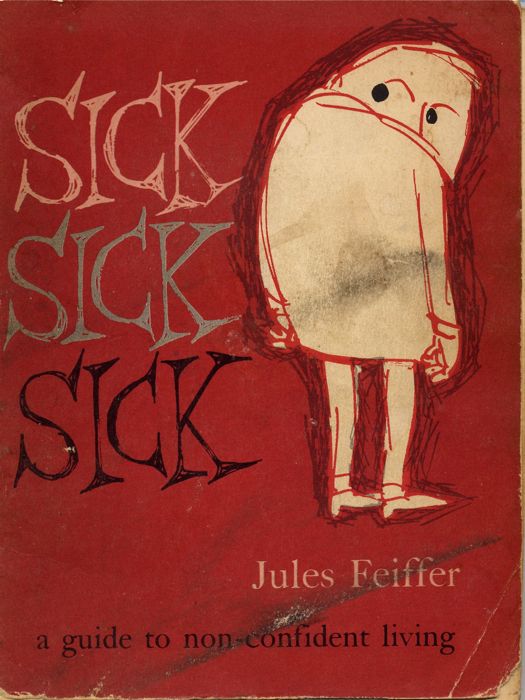
She talks about a report released in January this year by the Social Insurance Inspectorate which looked at the number of sick days taken by Swedes.

In 2005, 14% of the working age population were on sick and incapacity benefits. This was more than any of the 30 major countries in the OECD. Interestingly, over 50%of the Swedes who were on benefits were away for more than 6 months, compared to the other OECD ccountries where this figure was between 10-20%.

However, according to the report released in January, this has changed. The number of people on sick and incapacity benefits has dropped dramatically, as has the number of people on long-term benefits.

So, is this a miracle of health care? Has it do with an upsurge in national fitness levels? Has there been an increase in medication? No.

In 2008, the Swedish government introduced check-ups every three months for those on sick leave. And amazingly, many people have discovered that they are well enough to work after all.

According to the report, the Swedish state has saved 650 million crowns in benefit payments.

So that’s where the money came from to reimburse commuters for the delays in the public transportation system.

The Swedish pricks


When I was new in Sweden, I was walking down Katarinavägen on Södermalm with my Swedish mother-in-law. Katarinavägen has a fantastic view over the harbour and the city and far across the lake Mälaren. It was a beautiful day, the sun was shining and the air was crisp.

My mother-in-law, who doesn’t speak very good English, was struggling to keep the conversation going. She was pointing out different features in the cityscape. Over there is the animal park, over there is the green fairground.

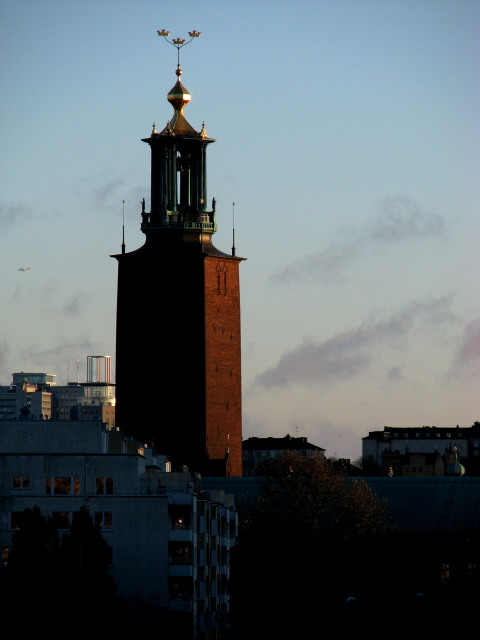
She pointed at the large building looming into the sky behind the old town. I knew this red-brick building to be the city hall. The city hall has a large tower and embellishing the top of the tower is the symbol of Sweden – three shining crowns.

My mother-in-law pointed at the tower and said proudly,

‘That is the town hall – the house with the pricks in.’

She was referring to the crowns as ‘the pricks’ and she meant to say ‘on’ the roof.

However, without knowing it, she couldn’t have been closer to the truth.

This year is election year. Let’s make sure that the pricks stay on the roof and not inside the building.

It only takes a moment


In my job, I have the good fortune to work in different countries around the world. On one such jaunt, I was asked to run a workshop in Dubai. It was around the time that the USA and UK had invaded Irak and there was, to put it mildly, a great deal of tension in the middle East. Being British was far from popular. There had been a few cases of kidnappings and murders of foreign business people.

With this in mind, my American colleage and I decided to pretend we were Swedish. We spoke only Swedish to each other in public places. We said ‘We’re from Sveden’ if anybody asked us. It worked really well. Being Swedish in the Middle East was not considered provocative. We were able to bask under the long-standing, international reputation of the Swedes as honest, neutral and decent.

And actually, these are three of the stereotypes that other cultures have of Sweden. Years of ‘good behaviour’ has positioned Sweden in the international arena as a decent nation with strong integrity. Except in Poland.

Listening to the radio today, I heard a Swedish correspondent living in Warsaw. He talked about how, until recently, he was proud to say he was Swedish. But lately, he denied it vehemently. Two major things have happened to sully the reputation of Sweden in Poland.

In September last year, Swedish stockpiles of Cold War-era canned meat were sold to Poland. The meat, some as old as 27 years, was sold by a Swedish trading company for use in restaurants in Poland. Experts said the meat should only be used up to 10 years after it was packaged. After tests at the Agricultural College in Warsaw, Poland, the canned meat was found to be turning rancid. Basically, the meat that Sweden had sold was not fit to give to a dog – but fine for Poles.

On Thursday this week, a Swedish man was arrested in Stockholm over the theft of the ‘Arbeit Macht Frei’ sign from the Auschwitz concentration camp in Poland. The metal sign was stolen in December 2009 from above the entrance to the notorious Nazi death camp. It was later recovered, cut into three pieces. The 5m (16ft) wrought iron sign – the words on which translate as “Work sets you free” – symbolises for many the atrocities of Nazi Germany.

The theft caused outrage in Israel, Poland and around the world. More than a million people – 90% of them Jews – were murdered by the Nazis at Auschwitz in occupied Poland during World War II.

So Sweden’s reputation is seriously, perhaps irretrievably, damaged in Poland.

It just goes to show that it can take decades to build a credible reputation but only moments to destroy it.

Fucking najs

Standing on the platform at Rådhus tube station today, I noticed the walls were plastered with adverts for Dramaten’s new production of Pygmalion. The slogan designed to attract an audience was – ‘Från Fucking Najs till Förtjusande.’ An interesting tagline.

Yet again, the word ‘fuck’ being bandied about in Swedish media. A while ago, the front page of Stockholm News was ‘Inte Fucka Upp’, and in another paper the journalist referred to someone as a ‘smooth motherfucker.’

I don’t get it. Why is the word ‘fuck’ considered ok to use in newspapers and other printed material in Sweden? Is it considered cool? International? Fashionable? I really don’t get it. As a native English speaker, I have nothing against swear words. But when swear words are used by non-natives, I find it inappropriate and quite franky embarrassing. For them.

Let’s be clear about something. The word ‘fuck’ is a really strong swear word. Sure, it’s thrown around on American and British films, but in every-day use, it is still a taboo word. When it is used, it’s a word most often reserved for use amongst friends and some families. I think it’s a big mistake for non-natives to swear in English. Without the understanding of the social and culural impact of the word, it can be very offensive. Not cool, or international or fashionable.

There’s a reason Dramatan has Eliza Doolittle saying ‘fucking najs’. This is meant to reflect that she is a vulgar guttersnipe not fit to mix with people who have a better command of the language.

I rest my case.

Drugs and sunbeds

Today, Sunday 17th January 2010 is a historic date. It is the day that the first non state-owned pharmacist opens its doors to the public. This marks the start of the dismanteling of a government-owned monopoly and is designed to give the public more freedom of choice and improved customer service. I applaud it.

This is indicative of the changing culture in Sweden – a move from state control to a privatised market defined by competition. It’s a move from collective control to individual choice.

However, Sweden’s national culture of collectivism sits deep and isn’t changed over one night.

The Swedish Radiation Safety Authority demanded this week that all local councils should immediately shut down their solariums due to health risks and prevent people from sunbathing. This is a clear example of the Swedish state attempting to control the choice of the individual citizen. Surely people have the right to choose if they want to visit solariums, no matter how unhealthy it might be, especially if it helps them get through the dark half of the year? Not everyone can afford a winter holiday abroad.

In the debate about privatisation of pharmacies, some Swedish politicians argued that releasing medicine freely on the market would turn Sweden into a nation of drug abusers. As if the average Swedish citizen is too simple-minded to handle the overwhelming access to paracetamol.

I guess it’s the same with sunbeds.